How can philanthropy infrastructure shape India’s development journey?
Source – India Philanthropy report 2026
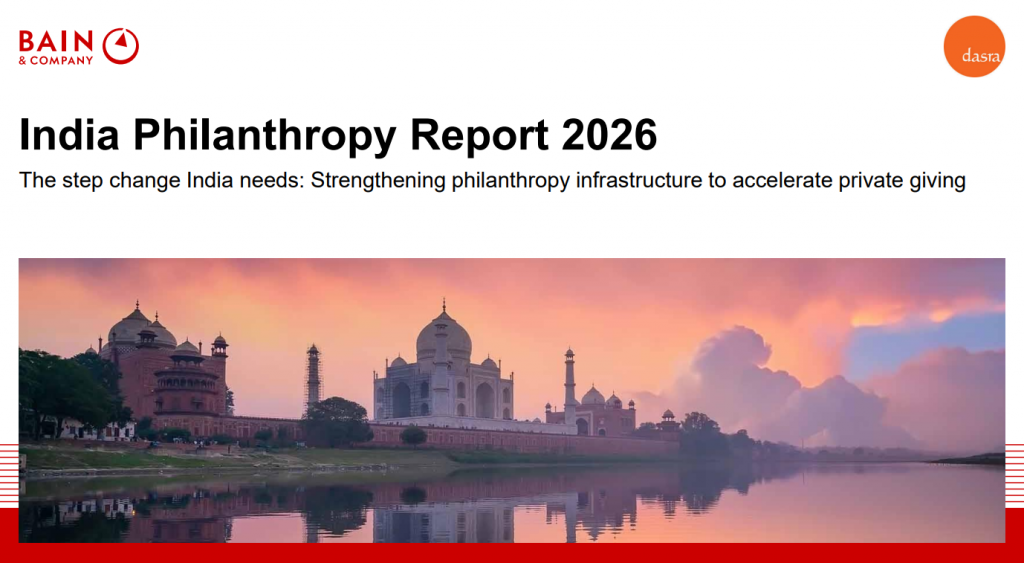
The latest India Philanthropy report 2026 by Bain & Company and Dasra highlights a critical moment for India’s social sector. Funding is growing steadily, reaching nearly INR 27 lakh crore by FY25 and projected to rise to INR 50 lakh crore by FY30. Yet, this growth masks a deeper challenge of demand outpacing supply.
The funding gap stands at around INR 16 lakh crore and is expected to widen further. Public spending accounts for nearly 95% of total funding, making it the backbone of the ecosystem. However, this also reveals a structural imbalance. Private philanthropy remains underdeveloped relative to India’s scale and ambition.
The report makes an argument that India needs more capital as well as a stronger system to facilitate giving. Strengthening philanthropy infrastructure is key to supporting the next phase of growth.
Key takeaways
Private giving needs to accelerate significantly
Private philanthropy is expected to reach INR 1.43 lakh crore by FY25, growing at 9–11% annually. However, this pace is not enough. To prevent the funding gap from widening, private giving would need to grow at over 25%.
This gap between current and required growth highlights a fundamental issue. While philanthropy is expanding, it is not scaling fast enough to match the country’s development needs. A step change in both volume and approach is required.
Families are at the centre of this shift
Families contribute around 42% of total private philanthropy, making them central to India’s giving ecosystem. This includes personal philanthropy as well as CSR from family-run businesses.
What is changing is how families are giving. Around 35% now support gender, equity, diversity, and inclusion, while 28% focus on climate and 27% on livelihoods. This signals a shift from traditional sectors to more diverse and systemic priorities.
Leadership is also evolving. Women lead philanthropic efforts in over 60% of families, and younger generations are playing a more active role. These shifts are reshaping both priorities and decision-making processes.
Philanthropy is becoming more structured
Nearly two-thirds of family philanthropies now rely on dedicated teams. This reflects a move towards more organised and strategic giving, with clearer governance and longer-term partnerships.
This transition allows for deeper engagement with social organisations and more sustained impact. At the same time, not all philanthropies have made this shift. Many continue to operate informally, limiting their ability to scale effectively.
Building capacity across the ecosystem will be essential to ensure that more organisations can move towards structured and outcome-driven approaches.
Capital is concentrated and unevenly distributed
Family-owned businesses account for 65–70% of CSR spending, but this capital is highly concentrated. Just 2–3% of families contribute nearly half of total CSR funds. There is also a geographic imbalance. States such as Maharashtra, Gujarat, and Delhi receive a larger share of funding, while states with higher poverty levels remain underfunded.
This uneven distribution reduces the overall effectiveness of philanthropic capital. Redirecting resources towards underserved regions presents a clear opportunity to improve equity and impact without increasing total funding.
New opportunities can expand scale
Three emerging trends could significantly expand philanthropic capital.
- First, the rise of family offices signals increasing institutionalisation of wealth, creating opportunities to integrate philanthropy into wealth management.
- Second, India’s diaspora (around 34 million) is becoming more engaged, contributing funds, expertise and networks.
- Third, as global aid declines, regional philanthropic hubs are gaining importance. Indian cities have demonstrated capability, but there is a need to build similar ecosystems apart from major metros.
These shifts could generate an additional INR 1.25–1.35 lakh crore in philanthropic capital by FY30.
Infrastructure is the key enabler
The report emphasises that realising this potential depends on strengthening philanthropy infrastructure. This includes intermediaries, advisory support, data systems, and talent. Without these, capital remains fragmented and underutilised. With them, philanthropy can become more strategic, collaborative, and effective.
India’s social sector stands at an inflection point. While funding has grown rapidly, the scale of need continues to outpace available resources. Public spending alone cannot close this gap. Private philanthropy must grow faster and operate more strategically.
The India Philanthropy Report 2026 makes it clear that this shift depends on strengthening the systems that support giving. The opportunity ahead lies in building this foundation that allows capital to move efficiently, reach underserved areas, and support long-term change. The step change India needs focuses on increasing giving while improving how it works, so that impact keeps pace with ambition.
You can read the full report here.